 Juice finance
 connects WETH collateral to USDB borrowing, strategy vaults and cross-margin health checks on Blast
Juice finance lets a borrower post WETH on Blast, borrow USDB into a protocol-managed account and use that balance in registered strategy vaults. Compatibility depends on the accepted collateral, available pool liquidity and chosen vault. A completed action appears in the account overview with updated balances, debt and health factor.
What Must Be Ready Before a Borrow?
WETH on Blast, a connected wallet and a created JuiceAccount must be ready before USDB can be borrowed. The protocol separates authorization, deposit, borrowing and vault placement into distinct transactions, so a wallet signature alone does not prove the asset reached the intended state.
| Stage | Confirmation or Blocking Condition |
|---|---|
| 1. Network readiness | The wallet is connected to Blast and can submit the transaction. A different network or insufficient gas prevents the intended contract call. |
| 2. Account creation | The JuiceAccount creation confirms and the account appears in the interface. Without the account, collateral, debt and positions cannot be tracked together. |
| 3. WETH authorization | The approval records an allowance for WETH. Approval alone does not move collateral or increase borrowing capacity. |
| 4. Collateral deposit | The account overview records the deposited WETH. A pending or failed deposit leaves the available borrow amount unchanged. |
| 5. USDB borrow | The request stays within the displayed remaining USDB limit. A failed borrow creates no new USDB balance or debt. |
| 6. Vault commitment | The selected vault is registered for the account and its deposit confirms. An unsupported destination cannot receive the account's borrowed funds. |
| 7. Vault position check | The vault position appears after the deposit confirms. If it does not, check the account's USDB balance and debt before attempting another strategy transaction. |
| Completion | Confirmed collateral, USDB, debt, vault position and health values reconcile with the intended action. |
Borrowing is the commitment point because it creates debt before a vault position exists. At that point, the managed account should show USDB, debt and a revised health factor. If the vault deposit later fails, the loan remains open and the USDB stays in the account rather than entering the strategy.
Borrowing Limits and Account Structure
Borrowing capacity comes from the account's collateral and current protocol parameters, not from the wallet's wider holdings.
The Credit Account
A JuiceAccount holds borrowed funds and strategy assets. Its owner initiates actions, while the manager enforces loan limits and registered strategy access. This arrangement supports cross-margin accounting because collateral, investments, credit and debt can be evaluated together rather than as unrelated wallet balances.
Remaining Borrowing Capacity
Juice finance documents borrowing of up to 3x the USDB value of deposited collateral. That ceiling does not mean every account can take the maximum. Collateral value, loan-to-value settings, existing debt, available liquidity and the amount displayed as remaining USDB all constrain the next request.
The displayed remaining amount is the practical boundary at submission time. It can change as prices, debt and protocol parameters change. A smaller borrow leaves more distance between the account and liquidation, while a larger one makes strategy losses or higher debt costs matter sooner.
How Does Cross-Margin Health Change the Decision?
Cross-margin health compares combined account equity with outstanding debt, so one weak position can affect the whole JuiceAccount. The manager values collateral, strategy investments and credit together, then tests whether that equity remains far enough above the loan value.
Liquidation begins when the account health factor reaches 125%. Once liquidation starts, ordinary account actions are disabled while strategy positions and collateral can be converted toward USDB debt repayment. Depositing USDB for repayment remains the route for restoring the account when debt is still outstanding.
Health can improve when collateral is added or debt is reduced. It can deteriorate when collateral or strategy values fall, borrowing costs accumulate or an oracle update changes the account's priced equity. Check the displayed health factor before borrowing, entering a vault or removing collateral.
Strategy Compatibility and External Risk
Strategy compatibility is limited to vaults registered for the JuiceAccount's manager. A random Blast application cannot receive borrowed USDB through the managed account merely because it accepts the same token.
The Registered Strategy Boundary
Registration gives the account a permitted route into a vault and lets the protocol include the position in cross-margin accounting. It does not make the external strategy interchangeable with another vault. Supported assets, withdrawal mechanics, fees and the way each position gains or loses value can differ.
Position-Level Exposure
Vaults can add external protocol, smart-contract, oracle and market-execution risk to the lending risk already present. Some integrations may hold liquidity positions, leveraged spot exposure, perpetual liquidity or managed pools. The selected vault's actual structure matters because a position loss can lower account equity even when the WETH collateral itself has not moved.
A reverted vault deposit does not erase debt created by an earlier borrow. The missing vault position and unchanged managed USDB balance distinguish this failure from a completed deposit. Borrowing interest continues until repayment, so the account-level balances must be reconciled before another strategy transaction is attempted.
When Is a Position Actually Closed?
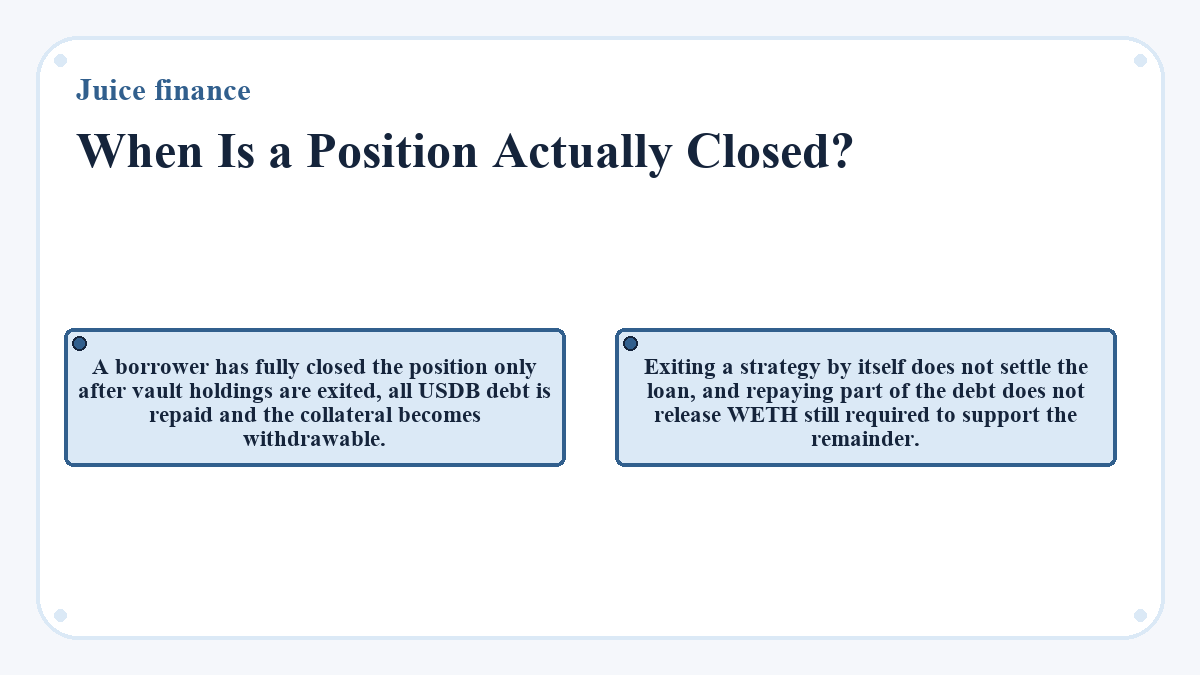
A borrower has fully closed the position only after vault holdings are exited, all USDB debt is repaid and the collateral becomes withdrawable. Exiting a strategy by itself does not settle the loan, and repaying part of the debt does not release WETH still required to support the remainder.
If a vault exit returns less USDB than the account owes, the borrower can deposit additional USDB into the JuiceAccount and use it for repayment. Once debt reaches zero, remaining USDB can be claimed and the deposited WETH can be withdrawn. These are separate state changes, each requiring its own confirmation.
Partial WETH withdrawals are limited to collateral not supporting an open loan at maximum utilization. The available withdrawal figure, rather than the original deposit, determines what can leave while debt remains. The next decision is whether to reduce debt further or keep enough collateral in place.
Lending Liquidity and Variable Costs
Lenders supply USDB or WETH to protocol pools. Borrowers can use WETH collateral for USDB debt or supported liquid restaking token (LRT) collateral for WETH debt, then place borrowed assets in registered strategies.
Supply-Side Liquidity
Lenders can supply USDB or WETH without selecting a strategy vault. Their ability to withdraw depends on available pool liquidity, so high utilization can delay an otherwise valid withdrawal. Bad debt is a separate risk: if liquidation proceeds cannot cover a loan, lenders may absorb the shortfall on a pro rata basis.
Interest and Protocol Fees
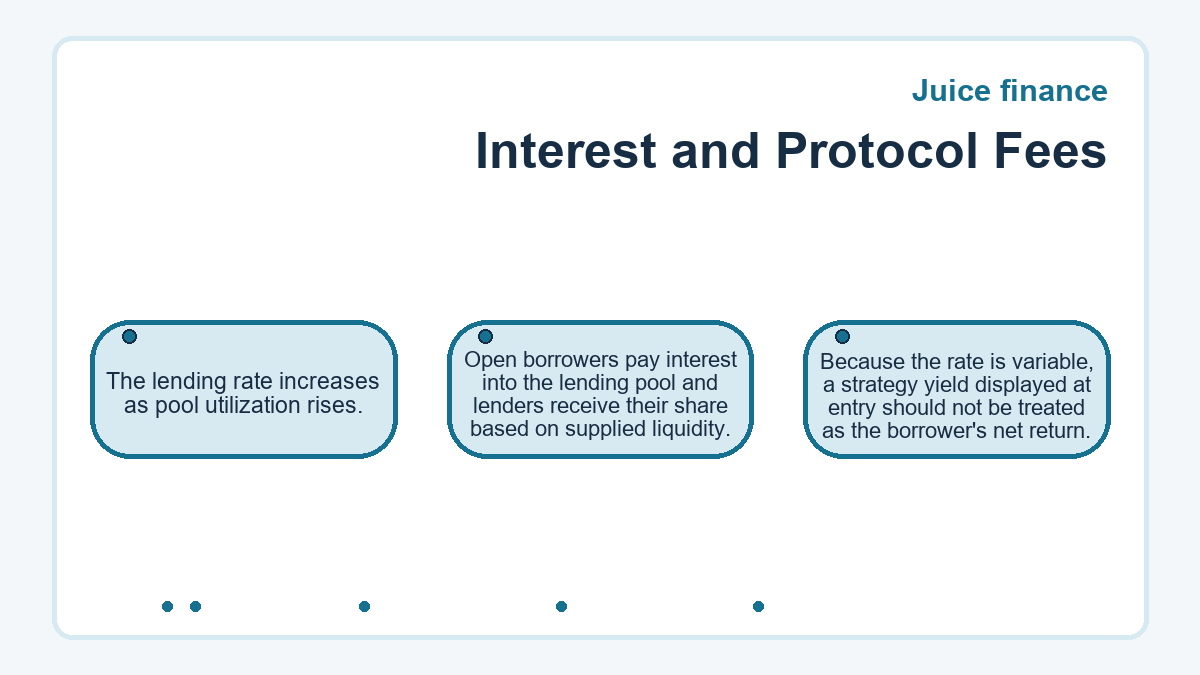
The lending rate increases as pool utilization rises. Open borrowers pay interest into the lending pool and lenders receive their share based on supplied liquidity. Because the rate is variable, a strategy yield displayed at entry should not be treated as the borrower's net return.
Strategy deposit fees can vary by vault and should appear with that vault's terms. Liquidation and external-protocol fees may also affect the final balance. The relevant comparison is between the account's realized strategy value and its debt, accrued interest and applicable fees, not a single advertised percentage.
Result Checks Before the Next Commitment
A valid result is visible in both the transaction status and the JuiceAccount state. After collateral is deposited, WETH and remaining borrowing capacity should update. After a borrow, USDB and debt should move together. After a vault deposit, the strategy position should appear and the health factor should reflect the account's new exposure.
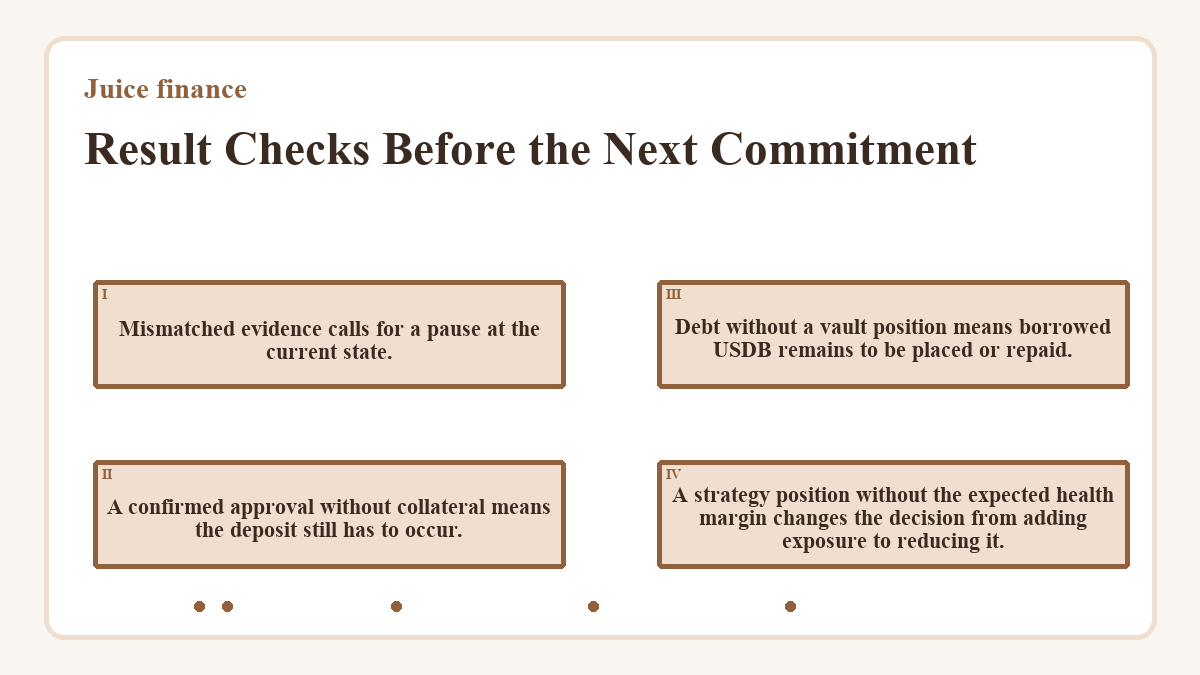
Mismatched evidence calls for a pause at the current state. A confirmed approval without collateral means the deposit still has to occur. Debt without a vault position means borrowed USDB remains to be placed or repaid. A strategy position without the expected health margin changes the decision from adding exposure to reducing it.
Useful questions about Juice finance
Can Native ETH Be Used for Borrower Collateral?
Only after it is wrapped into WETH. The borrow flow places an ETH wrapping control beside the collateral deposit, so native ETH first becomes WETH before the account can record it as collateral. A completed wrap is separate from the deposit transaction, which must confirm before borrowing capacity changes.
Where Does Borrowed USDB Appear After Confirmation?
Borrowed USDB appears inside the protocol-managed JuiceAccount, not as an unrestricted wallet balance. The account can place it in registered strategies or use it for debt repayment. If no vault deposit follows, the account should show the USDB balance beside the new debt and updated health factor.
Must WETH Approval and Deposit Confirm Separately?
Yes. Approval gives the collateral contract permission to transfer the specified WETH, while the deposit transaction moves it into the account's collateral balance. Borrowing capacity should remain unchanged after approval alone and update only after the deposit confirms and the account overview records the WETH.
Is a Delayed Lender Withdrawal Proof the Pool Is Insolvent?
No. High pool utilization can make liquidity unavailable for immediate withdrawal even when the pool is not insolvent. The relevant evidence is the available withdrawal amount and utilization state. Bad debt is a separate risk that can reduce lender recoveries on a pro rata basis.
What Happens If a Vault Exit Leaves Too Little USDB to Repay?
The borrower must add USDB to the JuiceAccount and use the repayment function to cover the remaining debt. Until the debt reaches zero, the account cannot complete a full collateral withdrawal. Any USDB left after repayment can be claimed separately from the deposited WETH.
Does a Healthy Account Remove Strategy and Oracle Risk?
No. The health factor is a liquidation metric, not a guarantee about a vault or its price inputs. External protocol failures, smart-contract defects, oracle problems and adverse execution can still reduce account equity. Those losses may push an otherwise healthy cross-margin account toward liquidation.