 Juice finance
 leverage: Step Comparisons and Account-State Gaps
Juice finance leverage links WETH collateral on Blast to USDB debt held by a JuiceAccount and, optionally, a registered strategy vault. To diagnose a mismatch, compare each confirmed transaction with the account's collateral, debt, remaining borrowing capacity, health factor and vault position before taking another action. Approval, deposit, borrow and vault entry are separate states, so an enabled button or wallet signature does not prove the expected account change occurred.
What Do Different Account Signals Confirm?
Each signal confirms a different stage: a wallet prompt shows an instruction, a successful receipt shows execution and the JuiceAccount fields show the resulting managed state. Compare every stage on the same dimensions: the asset or account expected to change, the record confirming the action and the next step the state permits.
A confirmed approval establishes a WETH allowance, but it does not add collateral. A confirmed deposit should raise deposited WETH. A successful borrow should raise USDB debt, reduce remaining borrowing capacity and leave the deposited WETH amount unchanged. Vault entry adds or updates a strategy position while the loan remains attached to the JuiceAccount.
Pending means the requested action has not reached a settled outcome. A failed or reverted transaction leaves the intended protocol state unchanged, although the wallet may still spend native ETH on gas. Success without the expected account change calls for an account, network and transaction comparison before any repeat submission.
Borrowing Capacity as a Live Constraint
Borrowing capacity is the first live constraint to compare when the requested leverage and displayed amount disagree. The protocol describes access to leverage of up to three times the USDB value of deposited collateral, but that ceiling does not grant every account the same loan. Collateral value, configured loan-to-value parameters, existing debt and available lending-pool liquidity affect the amount the account can borrow.
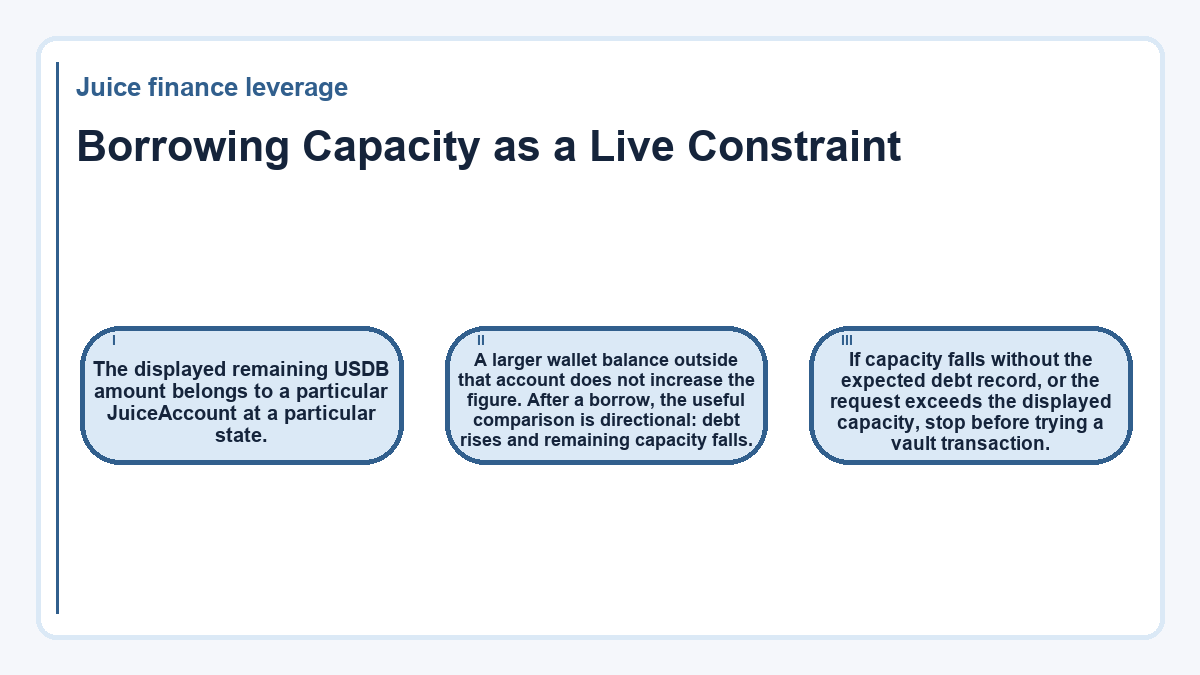
The displayed remaining USDB amount belongs to a particular JuiceAccount at a particular state. A larger wallet balance outside that account does not increase the figure. After a borrow, the useful comparison is directional: debt rises and remaining capacity falls. If capacity falls without the expected debt record, or the request exceeds the displayed capacity, stop before trying a vault transaction.
Wallet Evidence Versus Account Evidence
Wallet evidence describes authorization and transaction handling, while account evidence describes collateral, credit and strategy assets under protocol management. The wallet may show WETH, native ETH and transaction history. The JuiceAccount shows deposited collateral, outstanding USDB debt, health and managed positions. A borrowed balance can therefore exist inside the account without appearing as freely held USDB in the connected wallet.
Match the network, connected wallet, JuiceAccount and transaction target before interpreting a gap. Then compare the receipt with the field the action should change. An approval belongs with allowance, a deposit with collateral, a borrow with debt and capacity and a vault deposit with its managed position. This comparison prevents one valid record from being used as proof of a different step.
Health-Factor Gaps and Liquidation Exposure
Health-factor gaps arise because the protocol evaluates the account across collateral, investments, credit and debt rather than reading leverage from one token balance. Debt accrual, asset valuation and strategy performance can alter that relationship without another borrow. A health change should therefore be compared with the current WETH value, USDB debt and strategy valuation at the same account state.
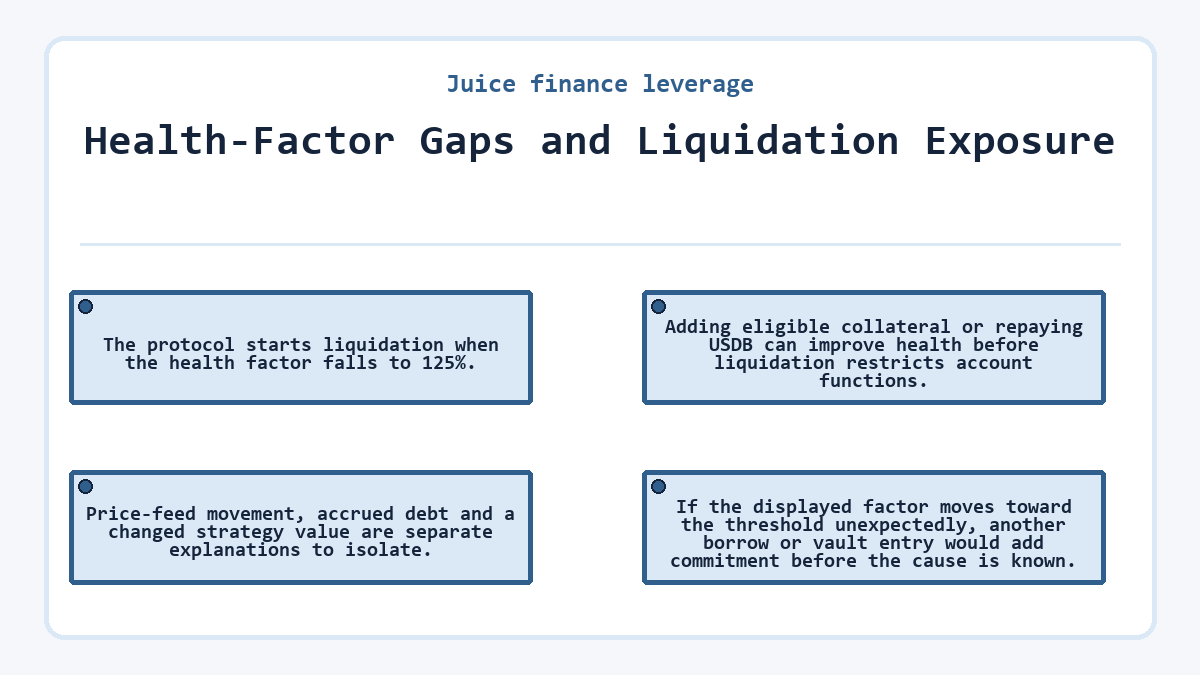
The protocol starts liquidation when the health factor falls to 125%. Adding eligible collateral or repaying USDB can improve health before liquidation restricts account functions. If the displayed factor moves toward the threshold unexpectedly, another borrow or vault entry would add commitment before the cause is known. Price-feed movement, accrued debt and a changed strategy value are separate explanations to isolate.
Vault State, Debt and Account Health
Vault state shows where managed assets are deployed, not whether the underlying loan has disappeared. Borrowed USDB first enters the JuiceAccount. A later vault transaction moves supported funds into a strategy registered for that account manager. The vault position then contributes to the cross-margin view alongside collateral, available credit and debt.
A successful borrow with no vault position means the account carries debt while the funds have not entered the intended strategy. A closed vault position with remaining USDB debt means the strategy exposure ended but the loan did not. Full WETH withdrawal requires open vault positions to be exited and outstanding debt to be repaid, so those states must be checked independently.
Cost Movements That Resemble New Borrowing
Cost movements can alter displayed balances without creating a second borrow. USDB debt accrues interest through the lending pool's borrow accounting, and the applicable rate responds to pool utilization. A strategy may also charge an entry fee disclosed for that vault. Neither movement should be diagnosed solely from the difference between an entered amount and a later displayed balance.
Separate each amount by location and unit. USDB debt belongs to the loan record, WETH belongs to collateral, strategy value belongs to the managed position and native ETH pays Blast transaction gas. Compare a debt increase with the borrow history and elapsed accrual. Compare a smaller vault credit with the displayed strategy fee and confirmed position rather than assuming the deposit failed.
Reversible Recovery for a Mismatched State
Start with the visible mismatch, do not submit another transaction while one is pending and check one dependency at a time. For a completed borrow, record collateral, debt, remaining capacity and health factor. Confirm the receipt, then reread the same JuiceAccount. Debt should rise, capacity should fall and WETH collateral should remain unchanged before a separate vault action begins.
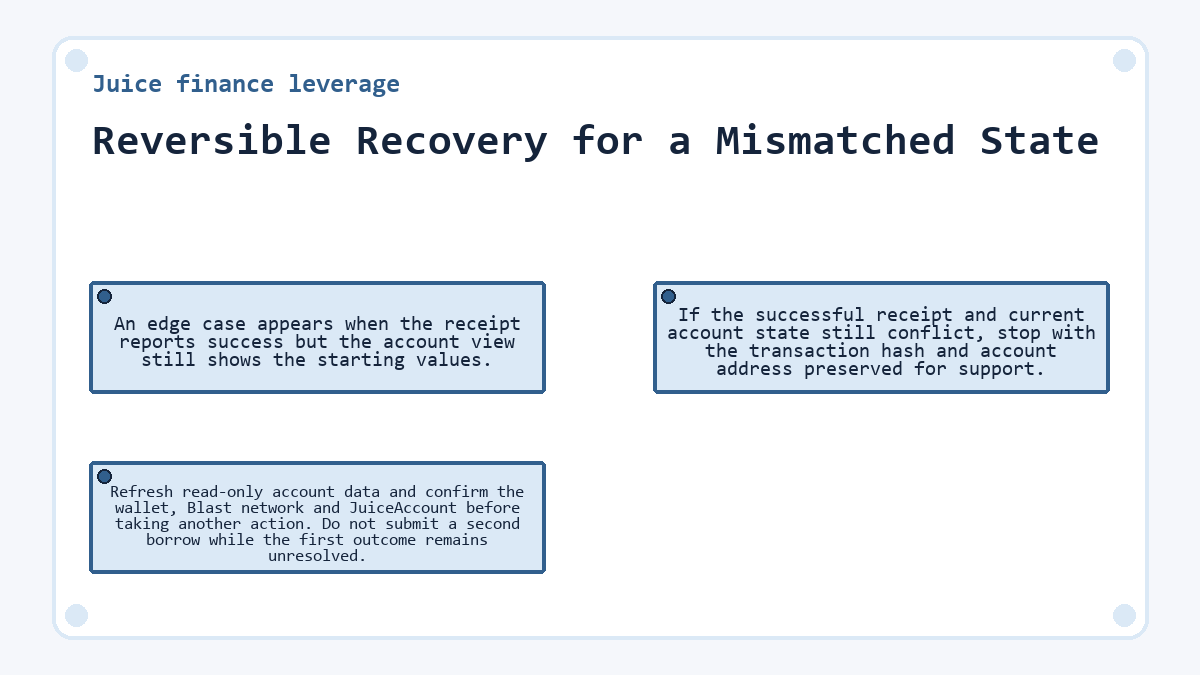
An edge case appears when the receipt reports success but the account view still shows the starting values. Refresh read-only account data and confirm the wallet, Blast network and JuiceAccount before taking another action. Do not submit a second borrow while the first outcome remains unresolved. If the successful receipt and current account state still conflict, stop with the transaction hash and account address preserved for support.
Before retrying, use this decision checklist:
- Confirm the pending transaction has reached a final success, failure or replacement state.
- Match the connected wallet, Blast network and JuiceAccount to the original request.
- Check WETH collateral only for a completed deposit or withdrawal.
- Check USDB debt and remaining capacity together after a borrow or repayment.
- Check the vault position and health factor before making another commitment.
Verification Before the Next Commitment
Verification is complete when the receipt and every affected account field describe the same transition. A deposit ends with higher WETH collateral. A borrow ends with higher USDB debt and lower remaining capacity. A vault entry ends with a managed position. Repayment ends with lower debt, while a full exit requires the debt to reach zero before all collateral can leave.
Unchanged fields after a failed transaction need no repair because the intended state never changed. Conflicting fields after a successful receipt require investigation, not another signed action. Continue only when the account state identifies where the WETH, borrowed USDB and strategy assets now reside and the health factor belongs to that same JuiceAccount.
Juice finance leverage: quick answers
Can USDB in the JuiceAccount Reduce Debt Without a Repay Call?
No. USDB must be in the JuiceAccount and the repay function must execute before the recorded debt falls. A transfer or account deposit changes the available USDB balance, while repayment applies that balance against the loan. Recheck debt and remaining capacity after the repayment receipt confirms.
Can a price-feed Update Change Health Without Another Borrow?
Yes. Health uses cross-margin valuations, so an oracle update can change the value assigned to collateral or strategy assets even when no new borrow occurs. Compare the changed valuation, debt balance and health factor together; a price-driven change should not be mistaken for a second loan.
Is a Second WETH Approval Needed After a Reverted Deposit?
Not necessarily. Approval and deposit are separate transactions. If approval confirmed, the remaining allowance may still cover another deposit attempt even when the deposit reverted. Check the allowance and the failed receipt before signing again; another approval changes permission, not the collateral balance.
When Should a Pending Borrow Be Retried?
Retry only after the pending transaction has a settled status and the account shows no completed borrow. Repeating the action too early can create replacement or duplicate behavior depending on nonce handling. Inspect the transaction and JuiceAccount first, then retry only when the earlier request can no longer execute.
Which Evidence Separates a Vault Fee From a Failed Deposit?
Compare the strategy's displayed entry fee with the confirmed receipt and the new account position. A disclosed fee can explain why the credited strategy amount is below the submitted USDB amount. No position, a failed receipt or an unexplained gap points to a different problem.