 Juice finance
 Separates the First Borrowing Commitment From a Full Collateral Exit
Juice finance lets a borrower stop at several distinct points: after creating a JuiceAccount, after depositing WETH, after borrowing USDB or after entering a registered strategy vault. Each point carries a different obligation. A full collateral exit requires every vault position to close, the outstanding USDB debt to reach zero and the remaining WETH withdrawal to confirm.
The commitment boundary is the confirmed account state, not the button pressed or wallet request signed. Confirm each state change on Blast before starting the next action.
A full collateral exit requires every vault position to close, all USDB debt to be repaid and the remaining WETH withdrawal to confirm.
Collateral, Credit and Vault Roles
The borrowing path ties together WETH collateral, a USDB loan and an optional strategy position. WETH supports the account's borrowing capacity, while borrowed USDB enters the JuiceAccount rather than becoming an unrestricted wallet balance. The account manager applies the loan limits, tracks debt and allows the managed account to interact with strategies registered by the protocol.
Strategy selection changes the exposure without removing the loan. A vault can introduce market, liquidity, smart contract and external protocol risks on top of the existing debt. Leaving the USDB inside the account avoids that additional vault exposure, although the borrow remains open and continues to carry its own costs and health requirements.
What Must Be True Before the First Commitment?
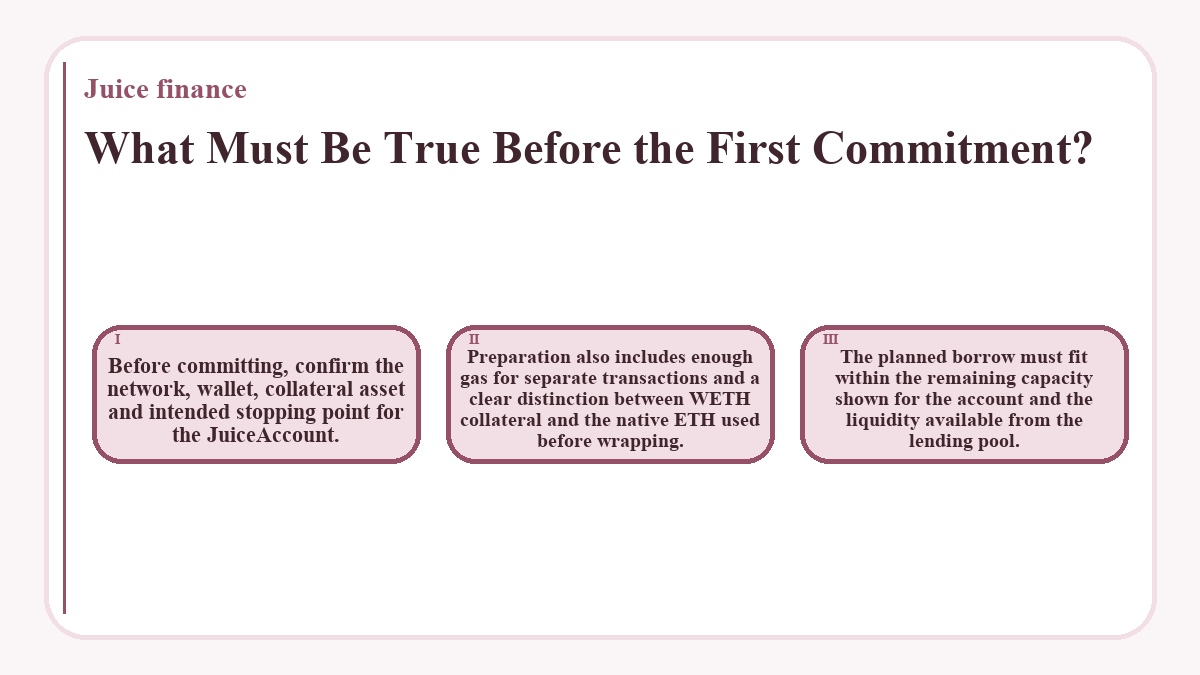
Before committing, confirm the network, wallet, collateral asset and intended stopping point for the JuiceAccount. Preparation also includes enough gas for separate transactions and a clear distinction between WETH collateral and the native ETH used before wrapping. The planned borrow must fit within the remaining capacity shown for the account and the liquidity available from the lending pool.
- The wallet is connected to Blast and either owns the intended JuiceAccount or will create it.
- The collateral balance is WETH on the same network.
- The WETH allowance covers the planned deposit, authorizes the expected spender and does not exceed the borrower's intended limit.
- The WETH deposit confirms before any USDB borrow is submitted.
- The chosen stopping point is clear before debt or a vault position opens.
Account creation, token approval and collateral deposit do not mean the same thing. Creating the account establishes the managed contract. Approval grants an allowance, while deposit moves WETH into the collateral state. Reading those events as one action makes it easy to borrow against a deposit still pending or repeat an approval which already succeeded.
Commitment Levels and Their Stop Conditions
The four commitment levels below differ by what has changed on-chain and what must happen before the borrower can leave that level. None has a standard duration.
| Position Choice | Recorded Change | Stop or Exit Condition |
|---|---|---|
| JuiceAccount only | The managed account exists, while WETH remains in the wallet | No debt or strategy position needs unwinding |
| Collateral only | WETH is deposited and USDB debt remains zero | Withdraw the confirmed collateral balance if no loan restricts it |
| Borrowed USDB held | The account records USDB debt and holds the borrowed balance | Repay the complete debt before withdrawing all WETH |
| Registered vault position | Account assets enter a supported strategy while debt remains open | Exit the vault, repay USDB and then withdraw the remaining collateral |
Moving down the table is optional rather than automatic. Deposited collateral does not require an immediate borrow, and a confirmed borrow does not require immediate vault placement. That separation creates useful stopping points, but only the first two avoid an open loan. Once debt exists, time, interest and account health remain relevant even during a pause.
Confirm One Action Before the Next
Each protocol action has one expected state change. Approval changes the WETH allowance without depositing collateral. Deposit increases the account's collateral. Borrowing increases both the USDB balance managed by the account and its debt, while vault entry moves the assets committed to the vault into a recorded strategy position.
A wallet signature only authorizes submission. The transaction receipt shows whether the request succeeded or reverted, and the account view should then display the corresponding balance or position. If the receipt and account state disagree, the next action should remain unsent while the existing transaction and selected account are checked.
Repeating a request before its status is clear can create a second valid transaction rather than repair the first one. Compare the network, account and requested action without signing again. If the transaction succeeded, continue from the recorded account state; if it reverted, decide whether to correct and resubmit the request.
Where Can You Pause Without Repeating an Action?
A clean pause comes after a confirmed state, with no transaction still pending. Stopping after account creation leaves funds in the wallet. Stopping after a WETH deposit but before borrowing avoids loan interest and liquidation exposure, although the collateral remains exposed to the protocol's contracts. A pause after borrowing is materially different because debt accrues variable interest and account health can change. Vault placement adds the performance and exit conditions of the external strategy. There is no universal safe pause duration because costs, utilization and asset values can move while the position remains open.
Full Withdrawal Has a Fixed Order
Full collateral withdrawal depends on clearing the obligations ahead of it. A borrower first removes assets from every open strategy, then uses available USDB to repay the loan. WETH becomes fully withdrawable only after the account no longer records outstanding debt.
All open vault positions must be exited and all borrowed USDB repaid before the full WETH collateral balance can be withdrawn. A partial WETH withdrawal may still be possible while a loan remains, but only for collateral the account does not need to support that open debt under the applicable utilization limit.
A vault exit does not promise enough USDB to settle the loan. Strategy performance, fees and accrued interest can leave the account short. In that state, the borrower must add USDB and call the repayment function before removing all collateral. If repayment leaves excess USDB after the debt is cleared, that remainder can be claimed separately.
When Does Liquidation Remove Your Choices?
Liquidation removes ordinary account choices when the health factor reaches the protocol's configured threshold. The displayed health factor reflects collateral, investments, credit and debt under the cross-margin calculation. Before liquidation starts, adding WETH collateral or repaying USDB can improve the account's health. Repayment may require a strategy withdrawal when the account does not otherwise hold enough USDB.
During liquidation, the protocol disables collateral deposits, collateral withdrawals, new borrows, claims and strategy deposits for the affected account. The automated process unwinds strategy positions and can convert collateral into USDB to repay debt. Once the debt is cleared, the account can return to a healthy state and any remaining USDB becomes claimable by its owner.
Costs That Follow the Open Debt
An open borrow carries a variable interest rate linked to lending-pool utilization. Higher utilization can increase the borrowing rate, so the amount required for repayment may continue changing after the original USDB reaches the account. The current debt record, rather than the initial borrowed amount, defines the repayment obligation at exit.
Vault costs form a separate layer. A strategy may apply an entry fee displayed for that vault, and its external protocol can produce gains or losses before the position closes. Blast gas charges also arise from approvals, deposits, borrowing, vault actions, repayment and withdrawal, but those network fees are separate from the USDB loan balance. Stopping before the borrow avoids loan interest; stopping afterward does not.
After Debt Reaches Zero
A zero-debt account has met its repayment obligation, but its remaining assets still need separate transactions. Excess USDB can be claimed, deposited WETH can be withdrawn and each completed transfer should appear in the destination balance. An empty account does not erase an ERC-20 allowance automatically, so allowance management remains separate from loan closure. Once the final withdrawal confirms, any later deposit or borrow begins a new commitment from the newly recorded state rather than continuing the old position.
Juice finance questions worth asking
-
Does Creating a JuiceAccount Move Any WETH?
- No. Creating a JuiceAccount establishes the managed smart contract used for borrowing and strategy interactions. WETH remains in the wallet until the owner approves the required allowance and submits a separate deposit transaction. Account creation alone does not produce collateral, USDB debt or a vault position.
-
Can I Revoke a WETH Approval After Deciding Not to Deposit?
- Yes. An ERC-20 approval is an allowance rather than a completed deposit, so the token holder can submit a separate transaction to reduce or revoke it. Revocation does not reverse any transfer already completed, and it requires its own network confirmation and gas charge.
-
Are Failed or Reverted Transactions Included in My Borrowing Limit?
- No. A failed or reverted transaction does not complete the requested protocol state change, so it does not add collateral or create USDB debt. The transaction may still consume gas. Check its final receipt and the JuiceAccount state before deciding whether a new request is necessary.
-
Does the Protocol Select a Strategy Vault for Me?
- No. The account owner chooses whether to use a vault and selects from strategies registered for the managed account. Registration limits where borrowed assets can be deployed, but it does not make every available strategy equivalent. Each vault retains its own positions, fees, exit conditions and external protocol exposure.
-
Is a Tiny Remaining USDB Debt Enough to Block a Full Collateral Exit?
- Yes. Full withdrawal requires all borrowed USDB debt to be repaid, even when the displayed remainder is small. Because interest can change the debt after the original borrow, use the account's current repayment value and wait for the repayment state to confirm before withdrawing all WETH.
-
Can Another Connected Wallet Finish the Exit?
- No. The connected wallet must own the relevant JuiceAccount to initiate its actions. Another address cannot close vault positions or withdraw collateral simply by opening the same interface.